
East Africa had been on our bucket list for a long time. It has pretty much everything a traveller could wish for: interesting cuisine, more diverse landscapes than you might expect, a fascinating history, world-class safaris, unique wildlife, and a big dose of raw adventure. If you’ve been following Farawayistan for a while, you’ll know our adventures have almost always happened on two wheels – except a canoe trip. This time, however, we traded our bikes for a 4×4 for our very first off-roading adventure by car.
Rwanda and Uganda are often overlooked, living in the shadow of Kenya, Tanzania and South Africa. Yet you’ll find the very same Big Five here, away from the crowds and often at a much friendlier price. While planning this trip, we quickly discovered how little practical information was available online. We could barely find a useful itinerary, let alone one we could use as a starting point. So, instead of another list of highlights, here’s our two-week road trip through Rwanda and Uganda. The places we stayed, the mistakes we made, and the moments that made this one of our favourite adventures so far.


Exploring Kigali: Rwanda’s Surprisingly Calm Capital
Kigali doesn’t feel like a typical large African city. It is almost unusually orderly. There’s no rubbish on the streets, hardly any traffic honking, and very little chaos. Low rise buildings cover the city’s countless rolling hills, while trees and gardens add greenery almost everywhere. It feels incredibly safe and pleasant to walk around, yet there’s also a slightly eerie feeling because of how little emotion people seem to express.
We stayed at Judith’s Hostel, next to Fika Café. As wannabe Swedes, we just had to. Both the hostel, with private rooms, and the café were excellent. From there, we explored Kimironko Market, wandered through the city, and enjoyed plenty of Rwandan coffee and meals centred around beans. We deliberately saved the Kigali Genocide Memorial for the end of the trip, as we’d be returning to the city before our flight home. After only a couple of days in Rwanda’s capital, and barely scratching the surface, we were already getting ready to cross the border into Uganda. The following morning, a man wearing a shiny light grey suit that was at least two sizes too big arrived at the hostel with his daughter to deliver our massive Toyota Land Cruiser Prado. Complete with a rooftop tent. The reviews turned out to be right after all. There had never been anything to worry about.


Lake Bunyonyi: Uganda’s Most Beautiful Lake
Before heading off, we had our first challenge to tackle. Rwanda drives on the right, yet our Ugandan Toyota Land Cruiser Prado also had the steering wheel on the right-hand side. It took Robin a while to stop turning on the windscreen wipers instead of the indicators after every corner. The driving position felt strange from the start, especially for the passenger, who suddenly found herself on the ‘wrong’ side of the road. Especially when turning left.
Driving in Rwanda itself isn’t that difficult. Not long after leaving Kigali, the scenery changed into quiet country roads surrounded by stunning landscapes. Then came challenge number two: the border crossing. Our passports and visas were fine, but there seemed to be a “big problem” with the car. We had specifically asked for a Ugandan registration plate, as foreign vehicles pay significantly higher fees in Uganda’s national parks. Unfortunately, our car had overstayed its visa in Rwanda. After a couple of hours, several phone calls and some mysterious banking magic, the friendly man in the shiny suit had sorted everything out. We never fully understood what happened, but eventually we were on our way.


Where Rwanda feels controlled, Uganda is unmistakably alive. It’s chaotic, unpredictable and messy, but in the best possible way. People are open, curious and ready for a chat. Lake Bunyonyi, however, felt like a safe haven. A quiet, almost unreal oasis. A deep lake winding through steep terraced hills, surrounded by green mountains and dotted with dozens of small islands. The staff at our lodge assured us there were no crocodiles, making it the perfect place for a swim. Later that afternoon, an otter joined us for our very first wildlife sighting of the trip. If there’s one thing you shouldn’t miss here, it’s an early morning birdwatching trip on the lake. At the time, Robin couldn’t have called Lake Bunyonyi the most scenic stop of the trip. Looking back, it probably was.

Queen Elizabeth National Park: Mud, Mountain Gorillas and Hippos
After leaving the shores of Lake Bunyonyi behind, we headed north for a long drive. And what a drive it was. The plan was to cut straight through Bwindi Impenetrable National Park. Despite its name, we managed to cross it, but it certainly wasn’t easy. Most of the route followed rough dirt roads. Heavy rain had turned the surface into thick, slippery red clay, sending the Land Cruiser sliding all over the road.
The dense rainforest of Bwindi Impenetrable National Park is home to one very special resident: the mountain gorilla. Nearly half of the world’s remaining mountain gorillas live here. Uganda, Rwanda and DR Congo are the only countries where you can go gorilla trekking. Unfortunately, permits don’t come cheap. At the time of writing, they cost between 800 and 1,500 USD per person. That was enough for us to skip it. A decision that later turned into the biggest case of FOMO of Robin’s life.


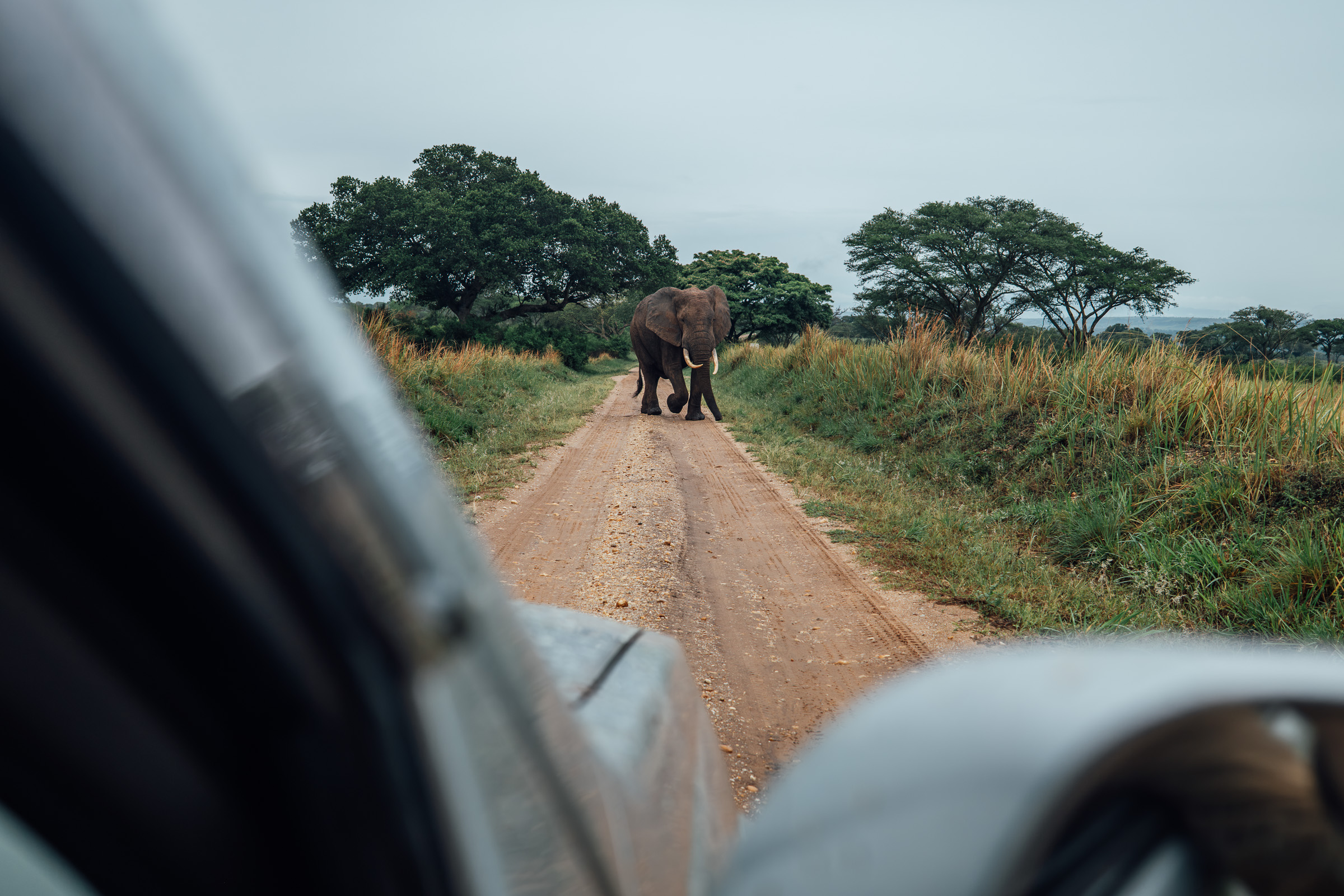
The road continued uncomfortably close to the border with DR Congo, where fighting between M23 rebels and the Congolese army was ongoing. On the Ugandan side, however, everything remained calm. Less calm were our reactions after spotting our very first elephant, casually grazing just outside the entrance to the Ishasha Sector of Queen Elizabeth National Park. We quickly realised wildlife doesn’t wait behind park fences.
At the gate, two Uganda Wildlife Authority rangers pointed us towards a designated campsite and casually mentioned that three park rangers and three soldiers would be spending the night with us. “For safety.” Zigzagging past elephants and hundreds of Uganda kobs, we eventually reached Ishasha River Camp. Dozens of hippos were sleeping on a mud bank less than 25 metres away, completely unaware of what was happening just across the river.


Mweya and the Kazinga Channel
Waking up in our rooftop tent with a fresh cup of coffee was soon followed by another highlight. One of the park rangers heard over the radio that a lion had been spotted somewhere near a tree about six kilometres away. Luckily, another safari vehicle had already found her. Otherwise, we would have driven straight past. A lone lioness slowly emerged from the tall grass and crossed the road with effortless elegance. Our very first wild lion.
The drive through Queen Elizabeth National Park turned out to be just as memorable. Long dirt roads stretched across the savannah while buffaloes, Uganda kobs, warthogs and waterbucks seemed to appear around every corner. At one point, a local man on a motorbike used our Land Cruiser as a shield while passing a particularly stubborn elephant that had claimed the road for itself. Wildlife always has the right of way.

A quick stop in Katunguru introduced us to Uganda’s famous Rolex. Not the watch, but a freshly made chapati filled with eggs and vegetables, rolled up and served straight from a roadside grill. Delicious? Absolutely. Whether it was the Rolex or several nights of camping, our stomachs weren’t entirely convinced afterwards.
It was time to treat ourselves, so we checked into Mweya Safari Lodge. Situated above the Kazinga Channel, the lodge overlooks the channel itself on one side and Lake Edward on the other. On a clear day, you can even spot Mount Stanley in the distance at 5,109 metres above sea level. Sipping a cappuccino by the pool while watching hippos drift through the channel below, with Nile crocodiles resting along the shoreline, wasn’t a bad way to end the day.


Fort Portal and Uganda’s Crater Lakes
After checking out at the Katunguru Park Gate, we said goodbye to the Uganda Wildlife Authority ranger. His antique-looking automatic rifle casually hung over his shoulder. We crossed the main road and entered Queen Elizabeth National Park once again through the Kasenyi Gate.
The female ranger gave us vague directions over the radio. “Lions somewhere near a bush. Left turn, right turn, then a couple of kilometres from here.” It didn’t exactly sound helpful. Yet within minutes another safari vehicle pointed us in the right direction. A whole group of lions was resting beside the road. A few impressive males and a lionesses. Completely unfazed by our presence, they slowly walked towards our Land Cruiser before settling down in the only patch of shade they could find. Right next to the car. We sat there in complete silence, hardly believing what was happening. It was one of those moments that makes you realise Animal Planet leaves out one important detail: what lions actually smell like.


Around lunchtime we reached the Uganda Equator, just one day after the equinox. By pure coincidence, the sun was almost directly overhead. During the equinox, the midday sun reaches an angle of almost 90 degrees above the equator, meaning objects cast hardly any shadow. Oddly enough, we first had to register our visit by signing a large notebook with two park rangers sitting under a parasol. A funny welcome for a landmark in the middle of a giant parking lot with barely any visitors around.
From there we continued north through the crater lake region around Fort Portal. Ancient volcanic eruptions left behind dozens of deep blue crater lakes, surrounded by tea plantations and rolling green hills. Without much planning, Sabina stumbled upon Kaswa Lodge. As usual, we hadn’t made a reservation, but travelling in the off-season worked in our favour. We spent the evening milking cows, enjoying a home-cooked meal and relaxing at what turned out to be one of our favourite stays of the trip. In fact, we liked it so much that we returned for another night on our way back south.


Murchison Falls National Park: Where Wildlife Meets Oil
The drive to Murchison Falls National Park was a long one. Not long after pitching our rooftop tent, the skies opened. Within minutes our campsite had turned into a small river. Robin was trapped inside the tent while Sabina waited it out in the car, both wondering whether camping had really been such a good idea.
Before sunrise the next morning, we met our guide: an absolute badass female park ranger. One of the great things about travelling with your own vehicle in Uganda is that you can hire a ranger to join you for a game drive. It costs only a fraction of a fully organised safari and makes spotting wildlife so much easier. Even though we set off in complete darkness, she had already found giraffes, lions and a hyena within the first five minutes.

Murchison Falls National Park is both beautiful and slightly confusing. The Victoria Nile is the beating heart of the park, attracting an incredible amount of wildlife before crashing through the narrow gorge that forms the famous Murchison Falls. At the same time, TotalEnergies is developing a massive oil project here. Hundreds of planned oil wells, brand-new roads and heavy machinery create a strange contrast with the surrounding wilderness. The controversial East African Crude Oil Pipeline only adds to that feeling. Don’t get us wrong, Murchison Falls is absolutely worth visiting. We simply couldn’t ignore the uneasy mix between conservation and large-scale industry. And yes, we realise the irony from behind the wheel of our diesel Land Cruiser.
After another few nights of camping, we treated ourselves once again and checked into Paraa Safari Lodge. Overlooking the Victoria Nile, it felt almost surreal. There were more staff than guests, making the whole experience feel wonderfully private. The following morning we boarded a boat towards the park’s namesake. Watching the Nile squeeze through a gap only about seven metres wide before plunging more than 40 metres into the gorge is one of the most impressive natural spectacles in East Africa.


Ziwa Rhino Sanctuary
It was time to hit the road again, this time towards one of Uganda’s more unusual conservation projects: Ziwa Rhino Sanctuary. This privately owned reserve was created to bring rhinos back to Uganda. During Idi Amin’s regime and the years that followed, the country’s rhino population was wiped out by poaching. Starting with just six animals, the sanctuary is now home to around 50 southern white rhinos, protected around the clock by armed rangers and an electric fence.
The sanctuary’s 70 square kilometres consist mostly of open grassland, making it feel different from Uganda’s national parks. It’s home to far more than just rhinos. We came face to face with Uganda’s national bird, the elegant Grey Crowned Crane, spotted vervet monkeys with their unmistakable bright blue balls, and learned that the reserve is also home to the prehistoric-looking shoebill stork, a bird that looks more like a dinosaur than a bird. The real goal, however, has always been to return rhinos to Uganda’s national parks. And it finally happened. In March 2026, the first two of eight rhinos were successfully reintroduced into Kidepo Valley National Park after decades of absence.

If you decide to go rhino trekking, be aware that you won’t be sitting comfortably inside an air-conditioned safari vehicle. Nope. You’ll be heading out on foot. Before we set off, our ranger casually explained that rhinos don’t see very well. If one happened to charge us, we should simply zigzag and hide behind a tree. Somehow, that wasn’t quite as reassuring as he intended.
Fortunately, the rhinos had other plans. We quietly approached a small group grazing across the grassland and spent nearly an hour watching them from a safe distance. A whole 15 metres at max. Seeing an animal this enormous without the comfort of a vehicle between us was a different experience.


Kibale National Park: Chimpanzee Trekking
Since we skipped the expensive gorilla trek, chimpanzee trekking was something we definitely didn’t want to miss. That meant backtracking to Kibale National Park, Uganda’s chimpanzee trekking capital. We arrived slightly late, as our small group had already left. After signing a waiver, we were squeezed into a tiny minivan. You know it’s a small van when the park rangers can’t even hold their rifles upright. A short drive later we were dropped off along the roadside, where the real adventure began.
Only a few minutes into the walk, a wave of screams echoed through the forest. Moments later, around 25 chimpanzees burst out of the jungle, crossed the road right in front of us and disappeared into the forest on the other side. They looked nervous. Constantly glancing over their shoulders. Then the forest exploded with noise. One of the rangers suddenly shouted, “Forest elephant!” and started running in the opposite direction.


Only later did we learn that African forest elephants are among the most unpredictable and dangerous animals in the jungle. As our guide backed away, several armed park rangers stepped forward with their rifles ready. Luckily, whistling, shouting and clapping were enough to scare the elephant back into the forest. The restless behaviour of the chimpanzees suddenly made perfect sense.
Once everything settled down, the chimpanzees slowly returned. Some climbed down from the trees to feed on fallen fruit, others simply lay on the forest floor, while a few seemed perfectly happy to pose for our cameras. Watching them up close felt strangely familiar. Their facial expressions, the way they interacted with each other, even the curious looks they gave us. It was impossible not to recognise a little bit of ourselves in them. An unforgettable experience, and for us, the perfect alternative to gorilla trekking.


Lake Mburo National Park: Completing the Big Five
Our journey back towards Kigali pointed us in the direction of Lake Mburo National Park. It may be Uganda’s smallest savanna park, but it’s packed with wildlife. The wetlands alone are home to more than 315 bird species. We, however, had our sights set on something bigger. One final animal was still missing from our Big Five bingo card.
Even before reaching the official park gate, we were already excited after spotting our first zebras. Later we learned that Lake Mburo is home to more than 5,000 of them. By the end of the day, it genuinely felt like we’d seen every single one. To increase our chances of completing the Big Five, we booked a night game drive with a local driver and a park ranger armed with an enormous spotlight. After arriving at the campsite, we were politely asked to wait before pitching our rooftop tent. The resident monkeys have a reputation for opening, or simply ripping apart, tents in search of food.


It’s still a mystery how our driver managed to navigate the park in complete darkness. The game drive started well enough, with several hippos finally leaving the water under the cover of night to graze. Impressive, but they weren’t the reason we were there. We were looking for number five: the leopard.
Our female park ranger gave it everything she had. The spotlight swept across the savanna almost non-stop. Every pair of glowing eyes lasted no more than a second before she called it out. “Hyena.” “Warthog.” “Mongoose.” Then, all of a sudden, she shouted, “Leopard!”
There she was. A masterpiece with golden fur covered in perfect rosettes. Probably a female, judging by her elegant build. Every now and then she paused her hunt and calmly looked in our direction, almost as if she knew we’d been searching for her all this time. Just like that, our Big Five was complete.

Mgahinga National Park: Gorilla Trekking
Speaking of wildlife, Robin’s morning coffee ritual was brutally interrupted the following day. While firing up the stove for a cup of La Cabra steep coffee, the campsite guard suddenly started clapping and shouting. About thirty metres from our Land Cruiser, a part submarine, part bulldozer slowly emerged from the bushes. A hippopotamus. Apparently it had spent the night grazing around the campsite. Fortunately, it couldn’t have cared less about our existence and casually wandered back towards the river.
A little later we encountered another African classic. In the town with the wonderfully badass name Mbarara, our Land Cruiser ended up with a wheel clamp. Apparently, one of the previous renters had received a parking ticket there and never paid it. It sounded like a scam, but for 8 USD Robin decided it wasn’t worth finding out. Half an hour later we were back on the road, heading for another place with an equally badass name: Mgahinga National Park. Remember our financially responsible decision to skip gorilla trekking because of the eye-watering permit price? Well… that wisdom lasted about four days.

Gorilla trekking isn’t something you simply book at the park gate. You need permits, paperwork and approval from the Uganda Wildlife Authority. Unfortunately for us, it was the weekend and the UWA office in Kampala was closed. Luckily, Uganda doesn’t always run on office hours. Thanks to our incredibly helpful hotel owner, countless phone calls and a 1,750 USD debit card payment in a random convenience store, everything somehow came together. We chose Mgahinga over the more popular Bwindi National Park. It’s slightly harder to reach, but far quieter. Our trekking group consisted of just three people: a woman from Kampala and us.
After hiking through dense bamboo forest on the slopes of the 4,127-metre-high Mount Muhabura, an inactive volcano in the Virunga Mountains, we suddenly found ourselves standing only a few metres away from a family of endangered mountain gorillas. Around 1,000 remain in the wild. No zoo, documentary or YouTube video prepares you for that moment. A massive silverback quietly watching over his family. Juveniles climbing through the trees. Mothers feeding their young. They completely ignored us while we stood there trying to process what we were seeing. It was one of the most surreal wildlife experiences we’ve ever had. It was equal parts peaceful and intimidating. Every time a gorilla wandered within arm’s reach, Sabina nearly stopped breathing. Robin couldn’t stop smiling.


Gisenyi and Kibuye: Back to Rwanda
With the adrenaline still pumping after our gorilla trek, another challenge awaited us: crossing back into Rwanda. The border post at Kyanika was buzzing with people. Before even stepping out of the car, we were surrounded by self-appointed fixers eager to help us navigate the paperwork for a “small fee”. This time, though, everything went surprisingly smoothly. Maybe we had simply become hardened by the past few weeks.
Once the border formalities were behind us, it was time for another kind of adrenaline boost. Rwanda has an incredible specialty coffee scene, with cafés serving beans sourced directly from local farmers. We happily pulled over for a flat white and a cortado, brewed on a gleaming La Marzocco espresso machine. Judging by the number of laptops and Patagonia fleeces, we’d also found Rwanda’s unofficial expat headquarters.

Caffeinated once again, we continued south along the shores of Lake Kivu towards Kibuye. The route passes close to Gisenyi and the border with Goma, the Congolese city that has repeatedly made international headlines because of the conflict just across the border. It felt surreal knowing that millions of people were living through a very different reality only a few kilometres away.
Instead of visiting more national parks, we chose a slower pace. We’d had our fill of wildlife, and Rwanda’s park fees are considerably higher than those in Uganda. Kibuye turned out to be exactly what we needed. Quiet shores, lush green hills and Lake Kivu stretching towards the horizon, with small islands scattered across the water. We stayed with an American woman who had built a life here, far away from everything. It was simple, peaceful and exactly the reset we didn’t know we needed before returning to Kigali.


Back in Kigali
After weeks of early mornings, game drives and countless kilometres on the road, Kibuye was exactly the break we needed. We spent our days doing very little. Eating, reading and enjoying the view over Lake Kivu. The most active thing we managed was taking a small boat to one of the lake’s islands, home to millions of fruit bats hanging from the trees.
The drive back to Kigali took around four hours. Rwanda’s roads seemed to alternate between silky smooth asphalt and rough construction sites, as Chinese contractors are rapidly building a brand-new highway through the country’s endless green hills. The traffic gradually became busier as we approached the capital, bringing our road trip full circle.

Back in Kigali, there was one place we had deliberately saved until the very end: the Kigali Genocide Memorial. It felt like the right way to end our journey through Rwanda. A place that explains not only the country’s darkest chapter, but also helps you understand the remarkable recovery that followed. Beware: it’s very emotional and very confronting, but an essential visit.
Afterwards we grabbed one final fruit shake at the museum café. A heavy thunderstorm had knocked out the card terminal, so the staff simply smiled and gave us the drinks for free. We handed back the Land Cruiser to the man in the oversized shiny suit who had delivered it weeks earlier and his friend. This time, however, he was wearing nothing more than a T-shirt. They even gave us a lift to the airport. Small gestures, but the perfect ending to our time in Rwanda. What a journey. Go see this part of the world yourself!
Follow all our adventures on Instagram and explore the related posts for more stories!
Leave a Reply